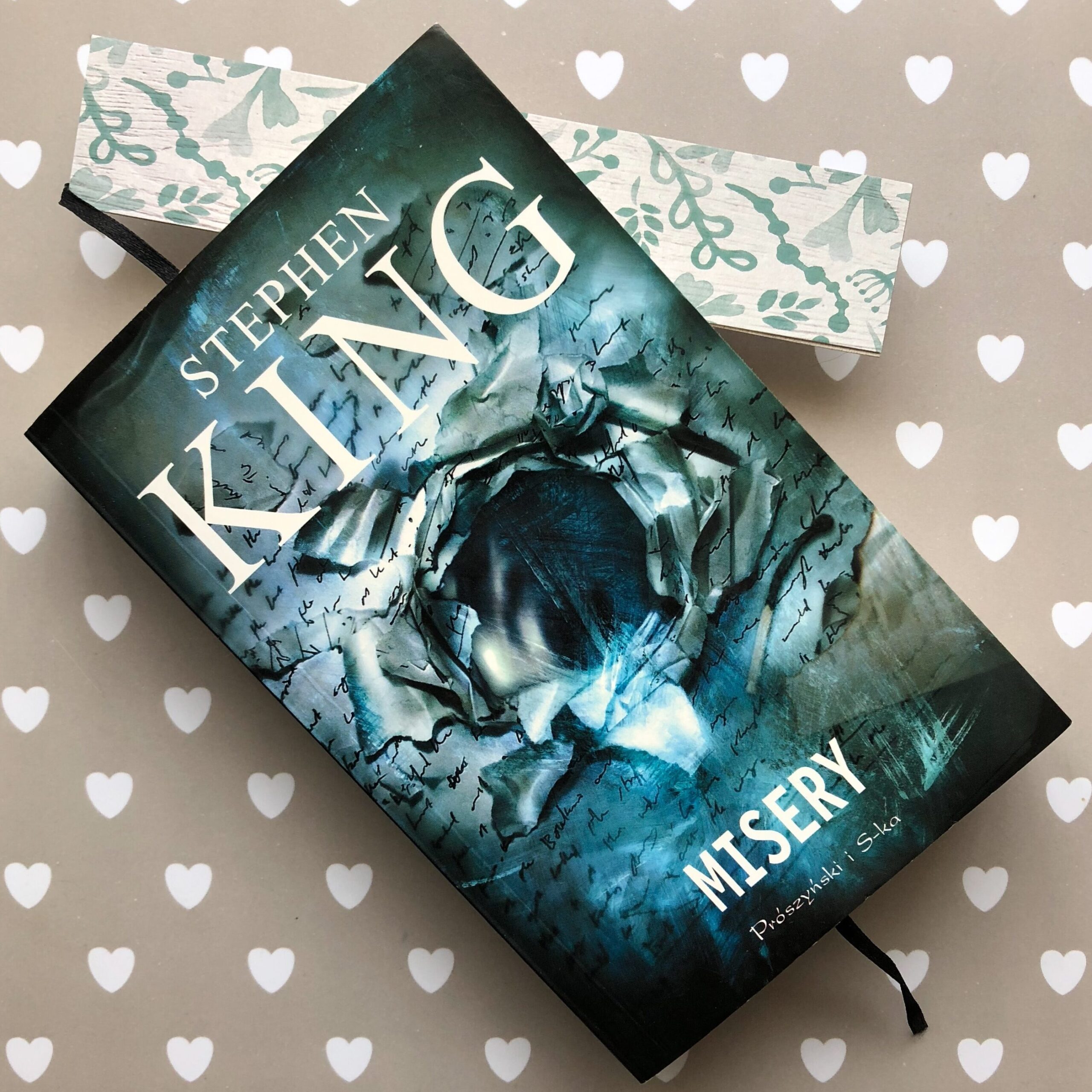
I’ve spoken before about why Stephen King is one of my heroes, but I’ve not yet discussed my favourite work of his, one that isn’t just a book I love, but a book that changed me. His novel Misery follows Paul Sheldon, a popular writer who has a car accident and is saved by Annie Wilkes, a kind retired nurse living in a snow-filled town. But when Annie discovers that Paul intends to kill Annie’s favourite character from a series he is tired of writing, she demands that things are changed, and with that, Stephen King changed the world of one of his readers.
Misery changed me in more ways than one (four, to be exact) and I can’t thank Stephen King enough for writing it. So, with some personal ground to cover, let me get into the next entry of my series ‘Works that Changed Me’ and explain how Misery by Stephen King changed me, and why you should check it out.
Change 1: It made me a horror junkie
Misery was the third Stephen King book I’d read, the last novel in a three-in-one collection I’d brought – this one to be exact – and while I’d enjoyed (and still do) Carrie and The Shining, they hadn’t changed me. But when I read Misery, I was thrust into a world of horror that was unlike anything I’d seen before. I was twelve at the time, and it changed me internally, and told me that horror was something I loved.
Before Reading Misery, I hadn’t explored horror very much, and had very limited knowledge of the genre. Reading those first few chapters changed me and I couldn’t stop reading (I read it for the first time over a couple of days), and King’s writing kept me wanting more of everything; the tension, the characters, the violence, the threat, and, of course, the horror. It had, in essence, changed me by opening me up to a genre I’d never been exposed to before.
Change 2: It made me understand that all great monsters are human
Another big way that reading Misery changed me was in showing me something I’d never seen in horror. I knew of the classic monsters and horror icons – and I love most of them to this day – but they were all beyond human. These monsters were supernaturally gifted, could invade dreams, and often no longer human (if they ever had been before), but Misery changed all that.
Annie Wilkes, in all her terrifying glory, changed my perspective of what a villain could be. Throughout the book, the villain of Misery has no supernatural powers, can’t travel to other worlds to torture Paul Sheldon, and her body doesn’t turn into a different form, and this changed the way I saw things as terrifying. Misery changed me by realising that the scariest villains are human. Soon after this, I was introduced to Hannibal Lecter, Jigsaw, and a host of other great human villains.
Don’t get me wrong, I can still look at drawings like this and a reaction can be produced, but monsters aren’t scary to me in the same way. The fact that Annie is so unextraordinary but dangerous makes her terrifying, and that changed me and how I understood villains.

Change 3: It made me want to be a writer
Morbid as this may sound, Misery was a book that changed me so much, it made me think about a different career. Until I read Misery, I planned on going into acting, and the book hadn’t changed me overnight, but after finishing the book, I started having that voice in my head, the one that dared to ask, ‘Could I tell stories like this?’
I’m not arrogant enough to think that I could write better than King (especially in Misery, seriously, it’s one of his best books), but his writing changed me enough to think that I would be able to pursue something that I hadn’t considered much before.
Change 4: It taught me the importance of constraints
Paul Sheldon spends the majority of Misery unable to walk and bedbound. Despite all these constraints, he became the protagonist of one of my favourite novels. I hadn’t encountered a horror story that had such a vulnerable protagonist before reading Misery, and the book managed to change that. Of course, ten years later I’ve read more books where the protagonist is limited, but it was Misery that changed me by showing me how effective this could be.
Constrained writing is a technique that can be used to constrain the writing, story, characters, and other elements of storytelling. Paul’s physical constraints could be viewed as a way to inspire creativity in the storytelling (I’m not saying that Stephen King did this, but it’s how I’ve read into it). I try to employ elements of it in my own writing, but more to the point, seeing how vulnerable Paul is in Misery changed me and the way I understood protagonists. Kurt Vonnegut said that no matter how sweet and innocent the lead character of a story is, punish them, and boy, does King do that in Misery. I won’t spoil things here, but check out the book, and you’ll see what I mean.
Change 5: It Made Me an Optimist
The final way that Misery changed me may be the most important one. I read Misery when I was twelve years old, with very few friends, and even less confidence. I didn’t understand the point in anything, and I didn’t see why I should be bothered with the outside world, but picking up that copy of Misery changed me and pushed me out of that position I’d been stuck in.
In Misery, Stephen King brought me into a world populated with characters I was enthralled by, a setting that terrified me, and a story that demanded my attention, one that made me happy. That book lit the fuse that brought my twelve-year-old self out of that rut and made me see the positive side of things. Of course, the novel is very dark, but in the novel’s fight for escape there is hope, and I hung onto that hope for myself. It’s believed that reading can make you happy, and while I’m not a bibliotherapy expert (though this article is a good place to start), I can say that reading Misery made me happier, if only for a little while. It’s odd to think, but writing this blog post made me realise how Misery changed the way I started to think about the outside world.
I’m so glad that King introduced me to Paul Sheldon, because his journey to freedom changed me more than I can describe. it made me want to be a writer, and it made me more of an optimist – he literally brought me out of my misery.
I can’t say that it will have the same effect on you, but if you haven’t read Misery before, please check it out. Aside from the ways it’s changed me, it’s a great story, filled with tension, and made me squint in one scene. And if you don’t want to read it, the film is also great.
Have you read Misery? What works have changed you? Let me know in the comments below!
Until next time,
Conrad 🙂

I haven’t read this book but I love that you took so much away from it.
It really motivated and changed me! If you haven’t read it, I don’t guarantee that it’ll change your life, but it’s pretty great. 🙂